
What should you look for when buying an under-sink water filter?
When buying an under-sink water filter, look for a system designed to address the contaminants in your water. Also consider its filtration method, flow rate, filter life, installation requirements, available cabinet space, and recognized performance certifications. In The Phoenix Valley, water testing can help identify which filtration features best match your household’s needs.
Which Contaminants Should an Under-Sink Water Filter Address?
The right under-sink water filter should be selected according to the substances present in the household’s water. Different filtration technologies address different water quality concerns, so choosing a system based only on appearance, brand, or the number of filtration stages may not produce the desired results.
Common under-sink filtration options include activated carbon filters and reverse osmosis systems. Carbon filtration may help reduce chlorine and compounds that affect taste or odor. Reverse osmosis uses a semipermeable membrane with additional filtration stages to reduce a broader range of dissolved substances. However, the precise performance varies by system and filter configuration.
Water testing can provide useful information before a system is selected. It helps identify the water conditions that need attention and allows those findings to be compared with the filter’s documented capabilities. This is particularly helpful in The Phoenix Valley, where homeowners may have different goals involving drinking water taste, dissolved minerals, or other water quality concerns.
What Filtration Features Should You Compare?
After identifying the relevant water conditions, compare how different systems filter and deliver water. A filter should provide enough capacity for the household’s typical drinking and cooking needs without creating an inconvenient reduction in water flow.
Important features to evaluate include:
- The filtration method and substances the system is designed to reduce
- The number and purpose of its filtration stages
- Its rated flow rate and daily production capacity
- Whether it uses a storage tank or tankless configuration
- The expected service life of each filter and membrane
- The availability of compatible replacement filters
- Recognized certifications for specific performance claims
A system with more stages is not automatically the better option. Each stage should have a clear purpose related to the water being treated. Likewise, a compact carbon filter may be appropriate for improving certain taste and odor concerns, while a reverse osmosis system may be considered when broader filtration is needed.
Recognized performance certifications are also important because they indicate that specific claims have been evaluated against established standards. Buyers should confirm exactly what a certification covers instead of assuming that it applies to every possible contaminant.
Will the Water Filter Fit Your Sink and Household Needs?
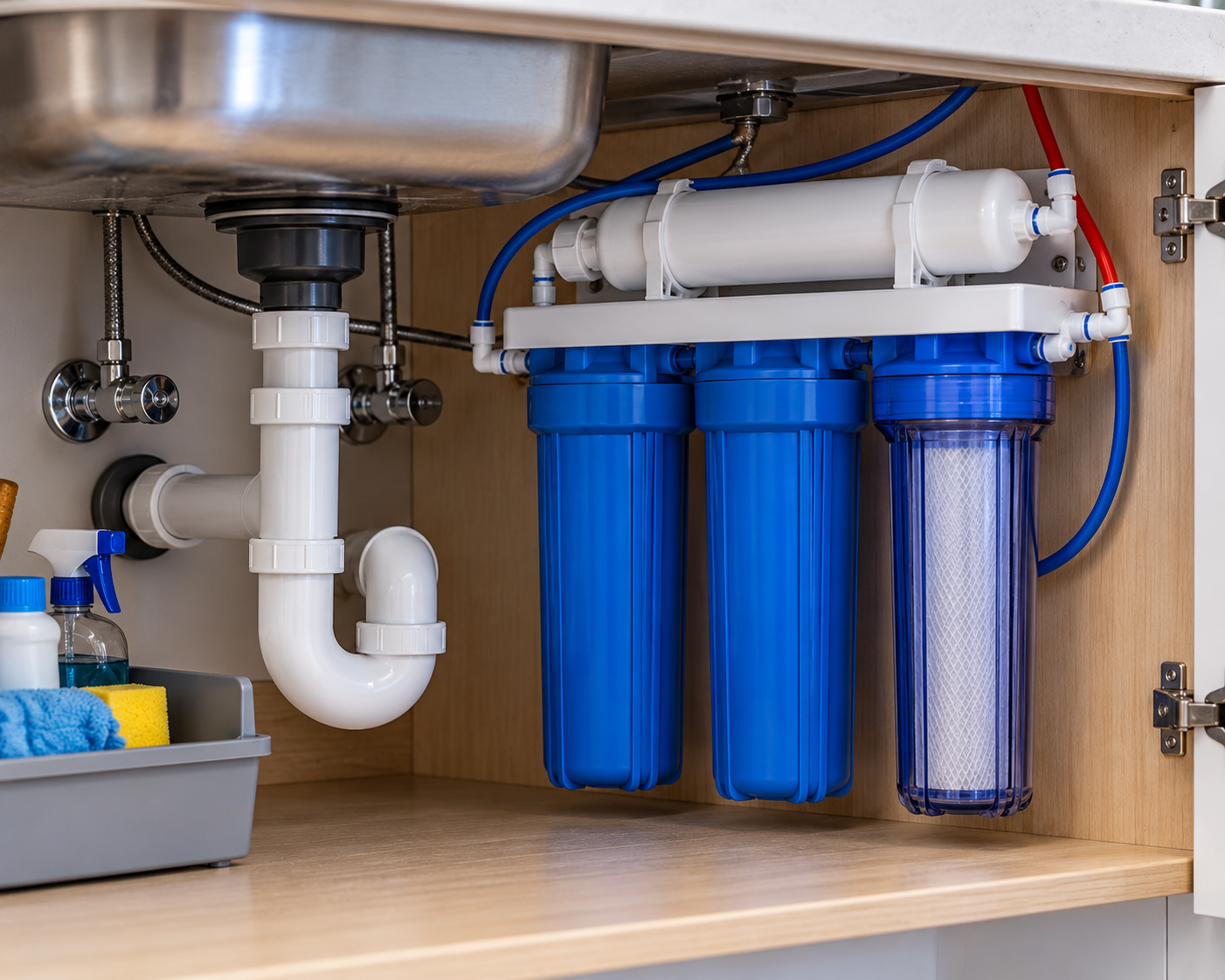
Available cabinet space is a practical part of choosing an under-sink water filter. Some systems require room for several filter housings, a membrane, a storage tank, tubing, and a dedicated faucet. Others use a smaller or tankless design. Measurements should account for plumbing lines, a garbage disposal, stored items, and access for future filter changes.
Installation requirements also vary. A system may need a dedicated drinking water faucet, a connection to the cold-water supply, a drain connection, or an electrical outlet. Reverse osmosis installation often involves more components than a basic inline carbon filter. Reviewing these requirements beforehand can help prevent compatibility issues and ensure that the system can be maintained safely.
Household usage matters as well. A system that serves one drinking faucet has different demands than one regularly supplying water for drinking, cooking, coffee, and ice. Flow rate, tank capacity, and recovery time can affect how consistently filtered water is available.
For households in The Phoenix Valley, professional water testing and an evaluation of the installation area can bring these factors together. The most appropriate system is one that addresses the identified water concerns, fits the available space, and supports normal household demand.
Why Do Filter Life and Maintenance Requirements Matter?
Every under-sink system requires ongoing maintenance. Sediment filters, carbon filters, and reverse osmosis membranes have different replacement schedules, which may also vary with water quality and usage. A system cannot continue performing as intended if its filters are neglected or incompatible replacement components are installed.
Before selecting a filter, determine which components require replacement, how accessible they will be beneath the sink, and whether replacement filters are readily available. Some housings require additional clearance for removal, while other systems use cartridges designed for simpler changes.
Maintenance should therefore be considered part of the original selection process. In other words, the best under-sink filter is not merely the one with the broadest list of features. It is a properly matched system that the household can operate and maintain consistently.
FAQ
Is reverse osmosis always the best under-sink filtration method?
No. Reverse osmosis provides broad filtration, but the appropriate method depends on the contaminants present, available space, desired flow rate, and the household’s water usage.
Should you test your water before choosing an under-sink filter?
Water testing can identify the conditions that need attention and help match them with a filter designed and certified to address those specific concerns.
Do under-sink water filters reduce water pressure?
Some systems can reduce flow at the dedicated faucet. The effect depends on the filtration method, system design, filter condition, incoming pressure, and household demand.
How much cabinet space does an under-sink filter require?
Space requirements vary considerably. Measure the cabinet and account for plumbing, disposal equipment, filter housings, a possible storage tank, and sufficient access for maintenance.
What should you look for when buying an under-sink water filter?
When buying an under-sink water filter, look for a system designed to address the contaminants in your water. Also consider its filtration method, flow rate, filter life, installation requirements, available cabinet space, and recognized performance certifications. In The Phoenix Valley, water testing can help identify which filtration features best match your household’s needs.
Conclusion
When buying an under-sink water filter, focus on the contaminants it is designed to reduce, its filtration technology, flow rate, maintenance needs, certifications, and compatibility with the available space. Water testing provides a clearer basis for comparing systems and selecting suitable filtration features.